
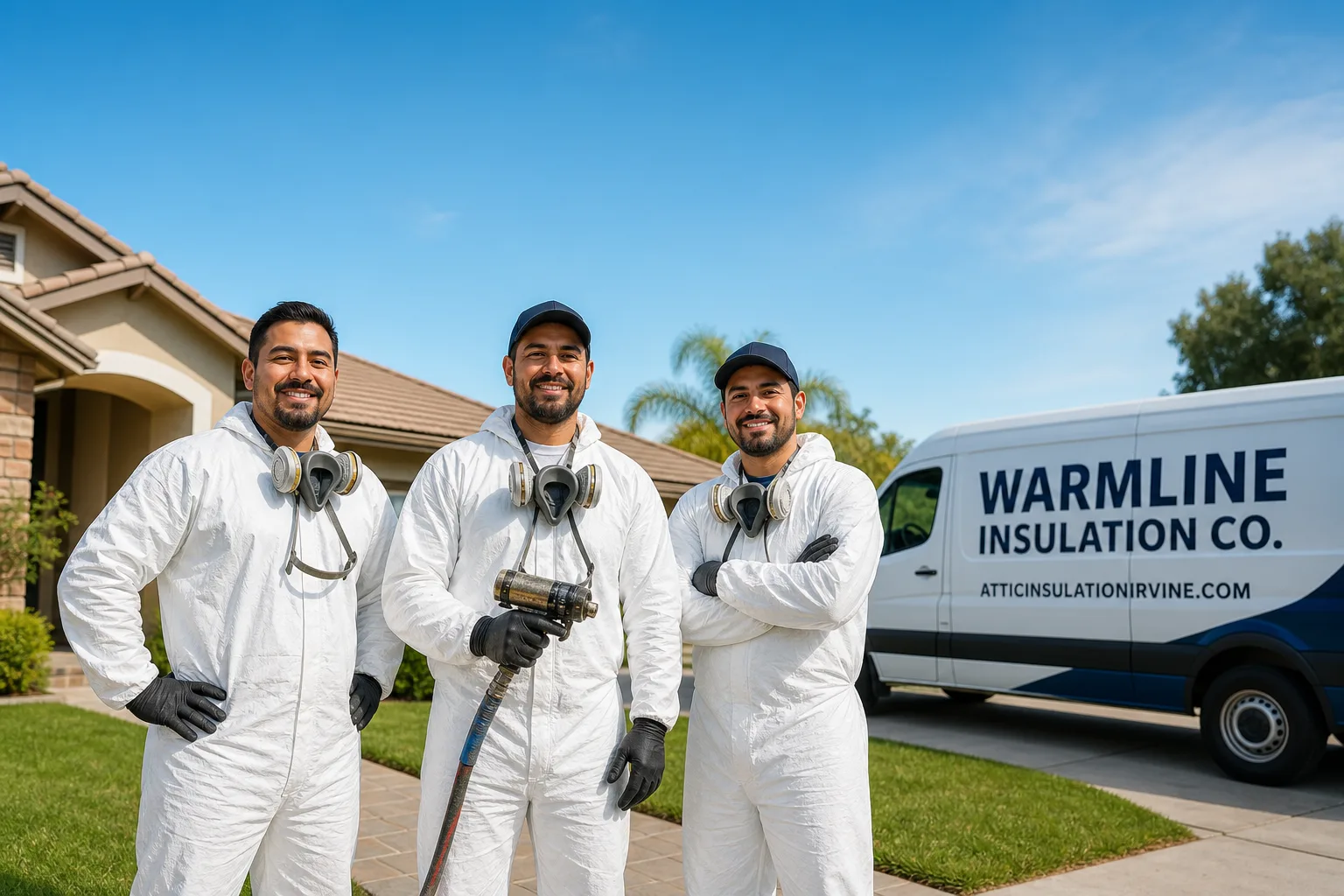
How Much Does Spray Foam Insulation Cost in Irvine?
Spray foam insulation in Irvine, CA typically costs between $1,800 and $6,500 for a standard residential project in 2026, depending on the type of foam, the area being treated, and the condition of the space. Most Irvine homeowners pay around $2,800 to $4,200 for a full attic or crawl space application using open-cell foam, while closed-cell projects run higher given the material’s density and performance specs. These figures reflect current labor and material costs in the Irvine market – not national averages that can be off by hundreds of dollars in either direction.
Spray Foam Insulation Cost Breakdown (2026)
The table below covers the most common our Spray Foam Insulation services projects we complete in Irvine homes each year. Prices reflect the full job – material, labor, and cleanup – with upfront pricing before any work begins.
| Application / Area | Foam Type | Typical Irvine Cost Range |
|---|---|---|
| Attic (1,000 sq ft) | Open-cell | $1,800 – $3,200 |
| Attic (1,000 sq ft) | Closed-cell | $3,000 – $5,200 |
| Crawl space encapsulation + spray foam | Closed-cell | $2,400 – $4,800 |
| Rim joists and band joists (full home) | Closed-cell | $600 – $1,400 |
| Garage ceiling (attached, 400 sq ft) | Open-cell | $900 – $1,600 |
| Wall cavities (exterior walls, per 100 sq ft) | Open or closed-cell | $350 – $700 |
| New construction – full building envelope | Closed-cell | $8,000 – $18,000+ |
| Air sealing + spray foam (targeted spots) | Closed-cell, 2-inch lift | $500 – $1,200 |
Per-Square-Foot and Per-Board-Foot Rates
If you’re comparing quotes and trying to decode the numbers, here’s how the math works in Irvine’s current market:
- Open-cell spray foam: $0.40 – $0.65 per board foot installed (one board foot = one square foot at one inch thick)
- Closed-cell spray foam: $1.00 – $1.60 per board foot installed
- Minimum project charge: Most reputable contractors in Irvine have a minimum visit charge in the $400 – $600 range, which covers equipment setup, mobilization, and PPE costs
Those per-board-foot numbers can move based on factors we’ll cover below. But if a contractor quotes you well outside those bands – especially dramatically below them – it’s worth asking which foam brand they’re using and what thickness they’re targeting. Products from Icynene, Demilec, and Johns Manville come with specific yield and performance data that a qualified contractor should be able to share without hesitation.
Why Irvine Pricing Sits Where It Does
Orange County labor rates run about 18-24% above the national average for skilled insulation work, and Irvine specifically adds local transportation costs, stricter South Coast AQMD air quality compliance for foam application, and higher material delivery overhead. That’s not a reason to overpay – it is a reason to be skeptical of quotes that look suspiciously cheap compared to what you see here. The foam chemistry, application thickness, and crew experience are where corners get cut when prices drop below market.
What Affects Spray Foam Insulation Pricing in Irvine
Six factors consistently move the final number up or down on any spray foam project we run in Irvine:
- Foam type: open-cell vs. closed-cell. Open-cell foam (roughly R-3.7 per inch) is the more budget-friendly option and works well in attic rafters and interior walls where moisture isn’t a primary concern. Closed-cell foam (R-6.5 to R-7 per inch) costs about twice as much per board foot but adds a vapor barrier, structural rigidity, and better performance in below-grade or crawl space applications. In Irvine’s mild but marine-influenced climate, closed-cell is often the right call for crawl spaces under homes in areas like Woodbridge and Turtle Rock, where ground moisture can be higher than expected.
- Project square footage and foam thickness required. Title 24 compliance in California currently sets minimum insulation requirements that affect how thick your foam application needs to be – and thickness is a direct cost multiplier. A 2-inch lift of closed-cell costs roughly half what a 4-inch lift does, and attic rafter applications in Irvine homes typically require 3 to 5 inches of closed-cell to meet current energy code for conditioned attic space.
- Accessibility of the space. A clean, open attic in a single-story home in Northwood is a straightforward job. A cramped crawl space under a split-level in Shady Canyon, or a multi-story home where equipment hoses need to run long distances, adds labor time and complexity. Confined space work, especially in crawl spaces under 18 inches of clearance, requires additional safety protocols that factor into the final price.
- Existing insulation removal. If there’s old fiberglass batt or blown-in cellulose that needs to come out before foam can be applied, add $0.80 to $1.50 per square foot for removal and disposal. In some older Irvine homes – particularly those built in the late 1970s and 1980s before current energy codes – we regularly find deteriorated batts that need to go before any new work begins. Our insulation removal and replacement service handles this in the same visit when possible.
- Substrate condition and prep work. Spray foam bonds directly to the substrate, so any pest damage, moisture staining, or mold needs to be addressed first. In Irvine homes near the wildland interface – parts of Turtle Rock, Shady Canyon, and areas backing up to the Lomas de Santiago foothills – attic pest intrusion is more common than you’d think, and remediation before foam application is non-negotiable. Our attic cleaning and rodent proofing service can handle this as a precursor step.
- Seasonal demand and scheduling. Irvine doesn’t get the extreme summer heat of the Inland Empire, but temperatures regularly push into the high 80s and low 90s from July through September, which is peak demand season for insulation upgrades. Booking in late fall or winter (November through February) often allows more scheduling flexibility, and some contractors – including us – can move faster during slower periods, which occasionally means better availability on short-notice jobs.
Open-Cell vs. Closed-Cell: Which One Do Irvine Homes Actually Need?
This question comes up on nearly every estimate call we take in Irvine, and the answer depends more on where the foam is going than on budget alone.
Open-Cell Foam
Open-cell is softer, more flexible, and significantly cheaper. It’s vapor-permeable, which means it allows moisture to pass through – a characteristic that’s fine in attic rafter bays where drying potential exists, but problematic in crawl spaces or below-grade walls where moisture control is the whole point. At roughly R-3.7 per inch, you need more of it to hit a given R-value target. For an Irvine attic rafter application targeting R-30, you’d need about 8 inches of open-cell foam. Icynene’s open-cell products and Demilec’s Sealection 500 are the industry benchmarks in this category.
Closed-Cell Foam
Closed-cell foam is denser, harder, and acts as its own vapor retarder. At R-6.5 to R-7 per inch, you hit R-30 at around 4.5 inches – half the thickness of open-cell, which matters in shallow rafter bays. In Irvine’s crawl spaces, rim joists, and any application where moisture or structural uplift is a concern, closed-cell is generally the right call. Johns Manville’s closed-cell products and Demilec’s Heatlok XT are formulations we use regularly for their consistent yield and long-term performance data.
Our Spray Foam Insulation in Irvine service page covers the technical comparison in more detail, including which applications are code-compliant under California’s current Title 24 requirements.
Irvine-Specific Considerations That Change the Math
South Coast AQMD Compliance
The South Coast Air Quality Management District – which covers all of Orange County – has stricter regulations on blowing agents used in certain spray foam formulations than most of the country. Any foam installer working legally in Irvine must use AQMD-compliant products, and not every foam brand sold nationwide qualifies. This narrows the product list somewhat and is one reason material costs in Orange County run slightly higher than the national average. It also means that contractors using non-compliant foam are cutting corners on both regulation and material quality.
Title 24 Energy Code Requirements
California’s Title 24 sets minimum R-values by climate zone. Irvine falls in Climate Zone 8, which requires R-19 in floors, R-13 in exterior walls (with a total assembly value that can be met different ways), and R-30 in ceilings/attics for residential construction. If you’re doing a full attic conversion to a conditioned attic space – which is popular in Irvine homes with HVAC equipment in the attic – the foam thickness requirements increase because the roofline becomes the thermal boundary. Your permit application will need to document compliance, and a good contractor handles that documentation as part of the job.
HOA Restrictions in Irvine
Irvine’s master-planned communities – Woodbridge, Northwood, Westpark, Quail Hill, and the newer Great Park Neighborhoods – all have active HOAs. Exterior foam work that changes the visible appearance of the home may require HOA approval, even if it’s on the permit-exempt list from the City of Irvine Building & Safety Division. Interior foam applications (attic, crawl space, rim joists) generally don’t trigger HOA review, but it’s worth checking your CC&Rs before scheduling anything visible.
How to Save on Spray Foam Insulation in Irvine
Spray foam is not the cheapest insulation option upfront – but the right project in the right location pays back in lower utility bills and reduced HVAC wear over time. Here’s how to get the best value on your project in Irvine specifically:
Start with a Home Energy Audit
Spending $300 to $500 on a professional energy audit before committing to spray foam can save you from applying expensive foam in the wrong places. We regularly find that Irvine homeowners asking for full-attic spray foam actually have a primary problem at the rim joists or duct penetrations – a $900 targeted application fixes 70% of the heat loss for a fraction of the full-attic cost. Our home energy audit service is specifically designed to give you this diagnostic picture before any material goes on a wall or ceiling.
Combine Services in One Visit
Mobilization is a real cost in spray foam work – setting up the rig, calibrating the proportioner, and heating the material to application temperature takes time and money regardless of project size. If you’re already opening up the attic for spray foam, adding rim joist sealing or targeted air sealing in the same visit costs a fraction of what it would as a separate trip. Most of our Irvine jobs are completed in a single visit, and combining scope is one of the easiest ways to lower your cost per square foot.
Qualify for Utility Rebates
Southern California Edison and SoCalGas both offer rebates for qualifying insulation upgrades, and Irvine homeowners are in the SCE service territory. Rebate amounts change annually, but qualifying spray foam projects with documented R-value improvements have historically returned $0.10 to $0.20 per square foot – not transformative, but real money on a large attic job. Your installer should be able to tell you which applications qualify and provide the documentation you need to file.
Ask About the Senior and Veteran Discount
Warmline Insulation Co. offers a permanent 5% discount for seniors and veterans – no expiration, no fine print. On a $4,000 project, that’s $200 back, just for asking. We also take $50 off any repair over $250, which applies to retrofit foam work addressing specific problem areas.
Get a Free Estimate Before You Commit to Anything
Foam thickness, substrate condition, and access complexity all have to be assessed in person before any honest contractor can give you a firm number. Call (949) 832-7835 and a live person will answer – not voicemail, not an automated system – to schedule your free estimate at a time that works for you. We price upfront, so you’ll know the full cost before we start the machine.
Is Spray Foam Insulation Worth It in Irvine?
For the right application, yes – consistently. Here’s the practical case:
Irvine’s climate (Climate Zone 8) is mild enough that homes don’t face the brutal summer penalty of the Inland Empire, but coastal marine air, June Gloom humidity, and Santa Ana wind events create thermal and moisture challenges that cheap insulation handles poorly. Spray foam’s air-sealing properties are particularly valuable in older Irvine homes from the 1970s and 1980s – neighborhoods like University Park, Rancho San Joaquin, and Turtle Rock – where the original fiberglass batts have settled, shifted, and left significant air gaps at top plates and penetrations.
A well-documented energy audit in a 1980s Irvine home with deteriorated attic insulation typically shows 25-40% of conditioned air loss attributable to air leakage rather than conduction. Spray foam addresses both problems simultaneously in a way that blown-in cellulose or batt replacement alone cannot. The upfront cost is higher, but the performance gap is real and measurable on your SCE bill within a billing cycle or two of completion.
We’ve been doing this work across Irvine and the surrounding Orange County communities since 2011 – that’s over 15 years of seeing which solutions hold up and which ones homeowners call us back to redo.
What to Expect from a Spray Foam Installation in Irvine
The Day-Of Process
Our uniformed, background-checked technicians arrive with all equipment staged in the truck – no surprises, no subcontractors you haven’t met. Before any foam is applied, we walk the space with you, confirm the scope against the written estimate, and mask off anything that needs to be protected. The proportioner (the machine that heats and mixes the two foam components) typically needs 20-30 minutes to reach operating temperature before spraying begins.
Application itself moves quickly – a 1,000-square-foot attic floor application takes roughly 2-4 hours depending on thickness and configuration. Closed-cell foam reaches handling strength in minutes and full cure within 24 hours. Open-cell foam can take a bit longer to off-gas, so we’ll advise you on ventilation timing for the specific product used.
After the Work Is Done
All of our spray foam work in Irvine is backed by our 90-Day Done Right Promise: if anything isn’t right after we leave, we come back and make it right – in writing, not just as a verbal assurance. This matters specifically with spray foam because adhesion failures or incomplete coverage aren’t always visible from the attic hatch. We document the application with photos before we close up.
Spray Foam vs. Other Insulation Options: Quick Cost Comparison
- Spray foam (open-cell): $0.40 – $0.65 per board foot – best air sealing, moderate R-value per inch
- Spray foam (closed-cell): $1.00 – $1.60 per board foot – best R-value per inch, built-in vapor barrier
- Blown-in cellulose (attic floor): $0.85 – $1.40 per square foot installed – good R-value for attic floors, no air sealing
- Fiberglass batt (wall cavities): $0.60 – $1.10 per square foot installed – lower cost, significantly less air sealing
- Rigid foam board (crawl space walls): $1.20 – $2.20 per square foot installed – good moisture resistance, labor-intensive to fit
Spray foam costs more per square foot than any of these alternatives, but it’s the only option that simultaneously insulates and air-seals in a single application. For spaces where air sealing matters most – attic bypasses, rim joists, crawl space walls – the premium is typically justified by performance. For straightforward attic floors where existing air sealing is already solid, blown-in cellulose from GreenFiber or Johns Manville may be the smarter value. Our home energy audit helps identify which solution belongs where – rather than defaulting to the most expensive option across the board.
Frequently Asked Questions: Spray Foam Insulation Cost in Irvine
How much does spray foam insulation cost per square foot in Irvine in 2026?
In Irvine’s current market, open-cell spray foam runs $0.40 to $0.65 per board foot installed, and closed-cell runs $1.00 to $1.60 per board foot. Translated to a common attic project: a 1,000-square-foot attic with open-cell foam at 3.5 inches thick typically costs $1,800 to $3,200 installed. Closed-cell at the same size and thickness runs $3,000 to $5,200. Call (949) 832-7835 for a free in-person estimate – these ranges tighten considerably once we see the specific space.
Is spray foam insulation worth the cost in Irvine compared to blown-in or batt insulation?
For most air-sealing applications – rim joists, attic bypasses, crawl space walls, duct chases – spray foam delivers measurable performance that blown-in and batt can’t match, because it eliminates air movement rather than just slowing conduction. In Irvine homes from the 1970s-1990s, air leakage typically accounts for a larger share of energy loss than conduction, which means spray foam often produces a bigger bill reduction per dollar spent than simply adding more blown-in on top of existing batts. For straightforward attic-floor depth increases where air sealing is already solid, blown-in cellulose can be the better value. Our energy audit service identifies which approach fits your specific home.
Does spray foam insulation require a permit in Irvine?
It depends on the scope. The City of Irvine Building & Safety Division generally requires permits for spray foam applied to the underside of roof sheathing (converting to a conditioned attic) or for projects that alter the thermal envelope in ways that trigger Title 24 compliance documentation. Targeted air sealing – filling rim joists, sealing penetrations, addressing specific bypasses – is often permit-exempt. We handle the permit determination as part of every project assessment and submit permit applications when required as part of the job scope.
How long does spray foam insulation last in an Irvine home?
Properly applied spray foam from established manufacturers like Icynene, Demilec, or Johns Manville has an expected service life of 80+ years when protected from UV exposure. It doesn’t settle, compress, or shift the way fiberglass batts do over time – which is one of the primary reasons we recommend it for spaces that are difficult to re-access. In Irvine’s relatively stable climate, we haven’t seen material degradation issues in any of the foam work we’ve done since 2011. The caveat is UV: exposed foam needs to be covered with a thermal barrier (drywall, plywood, or intumescent coating) per code, and open-cell foam exposed to direct sunlight will degrade.
Can spray foam insulation be installed in Irvine year-round?
Yes. Irvine’s climate is genuinely mild enough that temperature and humidity don’t create significant seasonal barriers to spray foam application the way they do in colder or more humid regions. The foam components need to be within a specific temperature range at the moment of application – our equipment handles that conditioning regardless of ambient conditions. Summer scheduling is busier (July through September), so lead times for non-emergency projects can run 1-2 weeks longer during peak season. Winter and spring scheduling typically allows for faster turnaround. Either way, call (949) 832-7835 and we’ll give you an honest availability window.
What is the minimum project cost for spray foam insulation in Irvine?
Most reputable spray foam contractors in Irvine have a minimum charge in the $400 to $600 range, reflecting the cost of equipment mobilization, PPE, and setup regardless of how small the application area is. If you have a specific problem area – a drafty rim joist, a penetration around a HVAC chase, or a small crawl space section – that minimum charge often covers the full targeted fix. For very small air sealing tasks, our targeted attic air sealing service may be a more efficient fit than a full foam mobilization.
Key Takeaways
- Spray foam insulation in Irvine costs $1,800 to $6,500 for most residential projects in 2026, with the typical range landing between $2,800 and $4,200 for attic and crawl space applications.
- Open-cell foam runs $0.40 to $0.65 per board foot; closed-cell runs $1.00 to $1.60 per board foot in the current Irvine market.
- South Coast AQMD compliance requirements narrow the approved product list and contribute to Orange County pricing running above the national average.
- A home energy audit before committing to spray foam often identifies targeted applications that deliver most of the benefit at a fraction of the full-scope cost.
- Irvine homeowners in Climate Zone 8 should confirm Title 24 compliance requirements with their contractor before finalizing scope – especially for conditioned attic conversions.
- Warmline’s 90-Day Done Right Promise applies to all spray foam work – if it’s not right after we leave, we come back and make it right.
- Seniors and veterans qualify for a permanent 5% discount on all services.
Get a Free Spray Foam Estimate in Irvine
If you’re ready to stop guessing and get a real number for your specific home, call (949) 832-7835. A live person answers every call – no voicemail, no callback queue – and we’ll schedule your free estimate at a time that actually works for your schedule. Most jobs are completed in a single visit, and you’ll have upfront pricing in hand before any foam goes on your walls or ceiling.
We’ve been doing insulation work in Irvine and across Orange County since 2011, and Neil Ashford has built Warmline Insulation Co. on the straightforward principle that homeowners deserve accurate information and work they can rely on. Explore everything we do on our home page, or go straight to the details on our Spray Foam Insulation in Irvine service page if you’re ready to compare options and book an estimate.
The 90-Day Done Right Promise covers every project we take on. If the work isn’t right, we make it right – that’s not a slogan, it’s a written commitment.
Written by Neil Ashford, Owner at Warmline Insulation Co., serving Irvine since 2011.
Pricing reflects the Irvine market as of 2026. Warmline Insulation Co. offers free estimates – call (949) 832-7835.
What Our Customers Say
"Injection foam in the walls of our 1950s house - no drywall demolition, just small holes patched and painted the same day. The street noise in the front bedroom is half what it was."
- Yasmin Farah"Crawl space smelled musty and the floors were cold. Full encapsulation with the thick liner taped at every seam, and a dehumidifier sized for the space. The hygrometer they left reads 48 percent now instead of the 70s."
- Elena Vasquez"Rodents had been in the attic for years before we bought the place. They vacuumed everything out, sanitized, sealed the entry points with mesh and foam, and only then put new insulation down. Photos of every stage before I paid."
- Darnell Whitfield